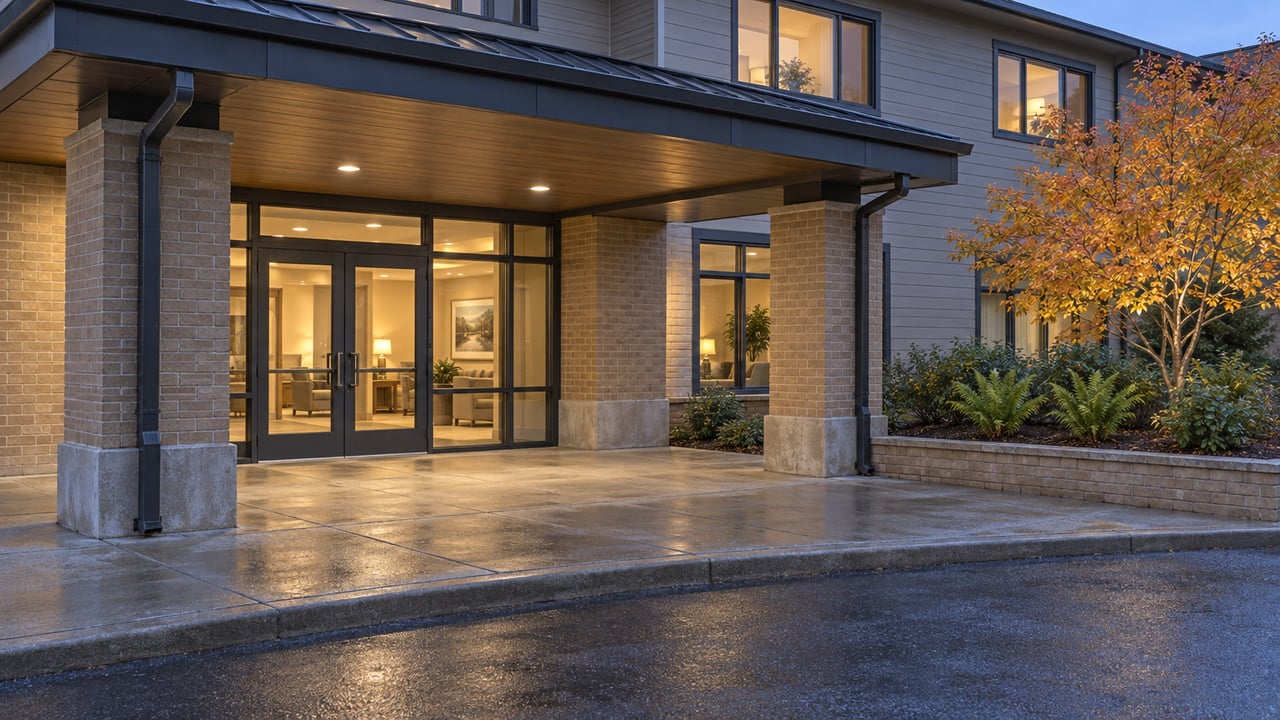
On July 1, 2026, Oregon raised Medicaid rates for residential care facilities by about 21.6%. Assisted living rates rose about 3%, and endorsed memory care rose about 2.1%. For anyone underwriting a Portland-area community this fall, the license class now sets the Medicaid revenue line before unit size, finishes, or vintage do. The state will also be back on site soon after any sale. Under the temporary ownership rule in effect through February 5, 2027, ODHS must inspect the facility no sooner than 90 days and no later than 120 days after a change of ownership. A buyer is pricing a revenue stream the legislature just reshaped, then proving operational control to a surveyor within four months of closing.
The rate schedule that widened the gap
The schedule in OAR 411-027-0170 has two blocks. One covers rates in effect from January 1, 2026. The other covers July 1, 2026, through June 30, 2027.
| Monthly Medicaid rate | January 1, 2026 | July 1, 2026 to June 30, 2027 | Change |
|---|---|---|---|
| Residential care, Tier 1 | $2,863 | $3,482 | about 21.6% |
| Residential care, Tier 5 | $5,172 | $6,290 | about 21.6% |
| Assisted living, Level 1 | $1,980 | $2,040 | about 3% |
| Assisted living, Level 5 | $4,649 | $4,789 | about 3% |
| Memory care, endorsed units only | $6,346 | $6,480 | about 2.1% |
Residential care already paid more than assisted living at the bottom and top of the scale in January. The July step widened that lead. At the lowest acuity, the spread between RCF Tier 1 and ALF Level 1 went from $883 a month to $1,442. At the top, the spread between RCF Tier 5 and ALF Level 5 went from $523 to $1,501.
The memory care comparison changes the most. In January, endorsed memory care paid $1,174 a month more than RCF Tier 5. As of July 2026, the gap is $190. A memory care endorsement brings a full layer of licensing and staffing obligations. Under the current schedule, it earns a Medicaid premium of under $200 a month over the top tier of a residential care license.
A budget note, not a demand signal
None of this reflects a shift in what Portland families are asking for. It traces back to the 2025 ODHS budget bill. SB 5526 included two budget notes. One directed a restructured rate method for adult foster homes, and the other directed one for standard licensed residential care facilities, both starting January 1, 2026. The RCF line carries $4.1 million in General Fund and $11.2 million in total funds, which ODHS described as a "biennial increase of 41.2%." The presentation doesn't say what baseline that 41.2% is measured from, so treat it as a budget figure. Don't divide it into the schedule.
ODHS laid out the problem it was fixing in its 2026 rate methodology presentation. From the 1980s through 2025, residential care paid a base rate plus one add-on, no matter how many daily activities required full assistance. The agency said that model failed to capture acuity, pushed RCFs toward specific-needs contracts, and contributed to delays in hospital discharges. The new model scores assessed ADL and IADL needs and adds points for cognition and for how often health-related tasks occur. Those scores sort residents into five tiers. The rulemaking notice says RCFs "will experience an additional rate tier higher than before."
The scope explains the split. The budget notes covered adult foster homes and standard RCFs, and the rulemaking describes no parallel redesign for assisted living or memory care. The smaller ALF and memory care increases came from a separate track that the legislature didn't restructure this cycle. No public source ties those smaller increases to a cost study.
What the residential care license permits
The rate gap matters for valuation because the two licenses describe physically different buildings. Oregon's RCF building rule allows bedroom-only units, caps a unit at two residents, and lets bathrooms sit outside the unit in a central location. ALF units must be self-contained apartments with lockable entry doors, private bathrooms, and kitchenettes, and new construction must provide 220 net square feet excluding the bathroom. ODHS's own summary describes RCFs as congregate settings with shared rooms.
Under the July 2026 schedule, the license with the lighter physical-plant standard carries the higher Medicaid rate at every comparable point on the scale. For a valuation, that cuts in several directions:
- Older RCF buildings that look dated on a tour may now hold Medicaid revenue that a newer apartment-style ALF nearby can't match per resident.
- ALF owners can't simply opt into the higher schedule. No rule we reviewed allows an automatic switch from ALF to RCF or routine dual licensure. The initial licensure rule asks applicants to state the facility type they intend to operate and describes a conversion path only for a nursing facility becoming an RCF. Any change in license class should be planned as a new ODHS approval.
- Memory care operators should test whether the endorsement's $190 monthly premium over RCF Tier 5 still covers the staffing and programming it requires.
The tier and level labels need care. RCF tiers come from the new acuity-based model, and ALF levels come from a separate assessment structure. A Tier 3 resident and a Level 3 resident are not the same person on paper. Any comparison between buildings has to come from actual resident assessments, not from lining up the schedule's rows.
Where the uplift stops
A 21.6% rate change is not a 21.6% revenue change. The schedule applies to Medicaid services funded through Aging and People with Disabilities. ODHS also says the new RCF rates did not affect facilities with specific-needs contracts. A building's exposure depends on how many residents are on Medicaid and which tiers they are assessed into.
Payer mix is the hardest number to pin down. Portland State University's research on Oregon assisted living and residential care settings found that Medicaid was the primary payer for an average of 42.3% of residents across license types. That figure comes from survey waves running from 2017 to 2019. It's a statewide historical average and doesn't describe any one building's census today. Margin has the same problem. A wage and cost study using July 2021 to June 2022 data found that median Medicaid payments covered roughly 75% to 88% of typical ALF and RCF costs, and reported average Portland Metro care costs of $5,193 per resident-month among regular Medicaid-contract respondents. Those numbers predate both 2026 rate steps and the wage changes since. They show the scale of the gap the legislature was addressing. They're not a current margin estimate.
Costs also apply to everyone in the building. ODHS notes that RCFs must staff to the acuity of all residents, and its rate assumptions build in wages, benefits, supervision ratios, building costs, and supplies. A higher Medicaid tier raises revenue on Medicaid residents only, while the staffing it implies applies to the whole floor.
Closing on an Oregon RCF in late 2026
The rate case for residential care is a transaction case, and the temporary OAR 411-054-0019 sets the clock. Here is the sequence a buyer should plan around for a closing before February 5, 2027:
- Sixty days before the proposed change. The current licensee and the prospective licensee each notify ODHS in writing. The buyer submits its application, background checks, policies, residency agreements, Consumer Summary Statement, its approved acuity-based staffing tool, and the licensing fee.
- Thirty days before. The prospective licensee notifies residents in writing, including any changes to rates or policies.
- One month before, for buyers new to Oregon. An applicant without Oregon ALF or RCF operating experience must contract with a consultant or management entity.
- Closing. The buyer may not take possession or control until ODHS approves the license. The seller remains responsible for operations until the new license issues.
- Days 90 to 120 after closing. ODHS inspects the facility.
Two other provisions shape deal structure. The temporary rules define the applicant to include owners and operators holding at least a 10% interest, and that threshold drops to 5% for facilities serving Medicaid residents. The RCFs gaining the most from the new schedule are by definition Medicaid-serving, so the lower threshold pulls more of a capital stack into licensing diligence. Separately, 2026's SB 1532 requires a condition on the license after a preliminary immediate-jeopardy finding that is reasonably likely to be substantiated. The facility gets a chance to submit evidence, and the condition comes off if the finding is not substantiated within 30 days. A condition imposed during a new owner's first inspection window would land just as the buyer is trying to show lenders stable operations at the new rates.
Portland's operator turnover is running on the same calendar
The rate change is arriving during an unusual stretch of operator change in the Portland area. Tigard-based Avamere planned 129 layoffs as it exited skilled nursing, OregonLive reported in August 2026, with most cuts in headquarters functions rather than resident care. In July 2026, Sabra Health Care REIT said it had letters of intent to re-tenant all 26 Avamere-leased properties, 22 of them to Cascadia Healthcare. The skilled nursing handoff was scheduled for October 1, pending regulatory approval. Five Avamere assisted living communities were also expected to change operators in October. As of October 4, 2026, we found no public confirmation that the handoff closed, and the five assisted living communities haven't been named.
Cascadia is adding more. Skilled Nursing News reported on September 30, 2026 that it plans to acquire 11 nursing facilities from Sapphire Health Services, expected to close December 1. It also plans to acquire Ohana Ventures' 14-facility portfolio, expected to close November 1: seven special-needs facilities and seven assisted living, independent living, or memory care facilities. The report didn't name the individual properties. On the dates announced, every Oregon assisted living or residential care asset in those deals would hit its 90-to-120-day inspection window between early 2027 and spring 2027, during the first full months of billing under the July schedule.
New supply won't change the picture soon. RoseVilla announced on September 29, 2026, that its Portland campus plans 97 new homes, 66 independent living and 31 assisted living, with construction starting in spring 2027 and completion expected in early 2029. NIC MAP data summarized in July 2026 put Portland's occupied penetration rate at 7.5% of age- and income-qualified adults 75 and older, among the three highest-penetration markets. NIC's public Q3 2026 release, dated October 1, reports national occupancy of 90.4% but no Portland metro figure. In a deep, mostly built-out market where license class now drives Medicaid revenue, the valuation question for an existing Portland community is which Oregon license it holds, how its Medicaid residents are assessed, and whether its operations will hold up at a state inspection 90 to 120 days after a sale.
If you own or plan to buy an Oregon residential care, assisted living, or memory care community, Senior Living Investment Brokerage can model your Medicaid census against the July 2026 schedule and plan your change-of-ownership timeline around ODHS's post-closing inspection. Get a Broker's Opinion of Value.